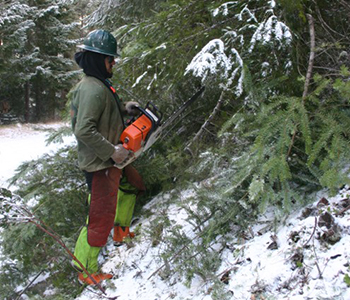
Forestry services work occurs nationwide yet is often hidden from the public eye. Injury and illness rates among workers in the forestry services industry are 2 to 3 times the rates of the average US worker, and fatality rates are 10 times as high (US BLS). It can be dangerous work, with job tasks involving the use of chainsaws, falling and burning trees and branches, carrying and lifting heavy loads, applying herbicides, and frequent awkward and repetitive motions. This industry manages forests for future harvest, reforestation, ecosystem management, and fuel management to prevent catastrophic wildfires.
Common injuries include severe cuts, strains and sprains, broken bones and dehydration. The largely migrant workforce in this industry is essential to US forest management, yet face added safety and health barriers because of contracted employment, lack of English and literacy proficiency, working in remote locations, and limited skills training.
Selected Articles & Resources
- Bilingual Pesticide Labels for Reforestation Worker Safety
- Work Organization and Injury Outcomes among Latino Forest Workers, Wilmsen 2019
- Working in the Shadows: Safety and Health in Forestry Services in Southern Oregon, Wilmsen 2015
- At Work in the Woods: Occupational Hazards of Harvesting Non-Timber Forest Products in the Pacific, Keifer 2019
- Forestry - Integrating Safety in a Time of Rapid Change, Harrington 2021
- Occupational Safety and Health in Forest Harvesting and Silviculture, Garland 2020
- Accident Analysis in Forestry: A practical field guide, Garland 2018