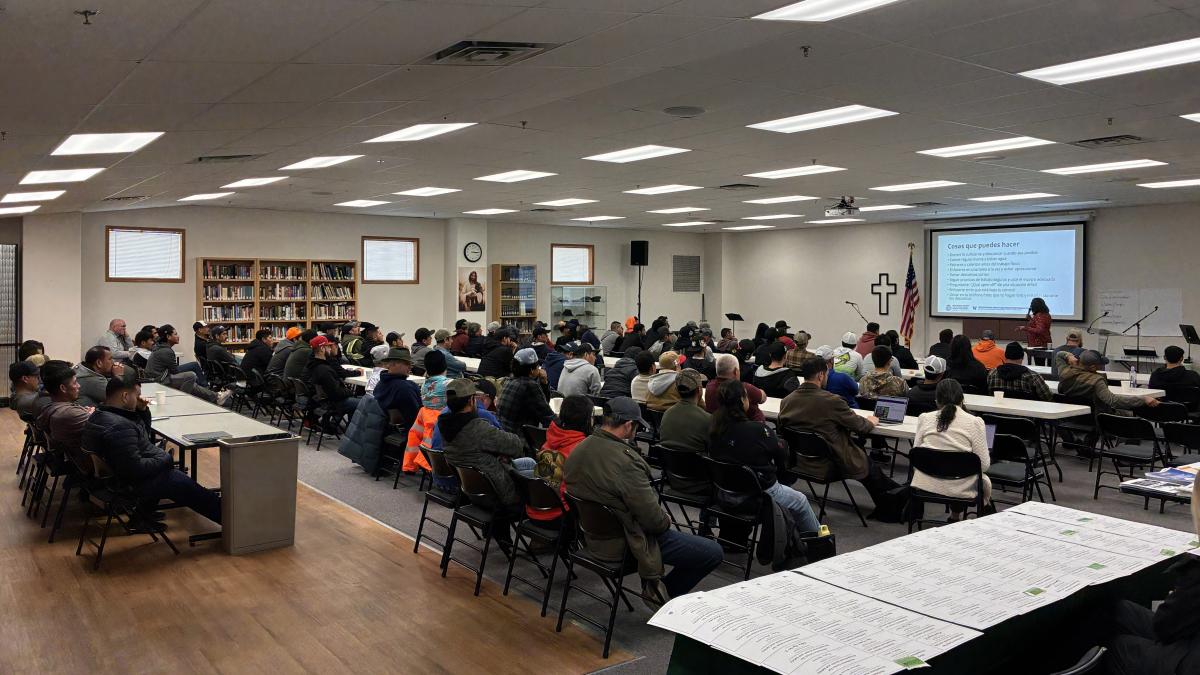
On a rainy morning in the Pacific Northwest, forestry services workers, supervisors, and business owners from across southwest Washington gathered in the town of Chehalis for a skills and safety workshop. This was not a typical gathering. In an industry where work is isolated and carried out in remote forested locations, this gathering was a rare meet-up for a unique community.
The workshop brought together 86 Spanish‑speaking participants from 12 different companies, representing diverse forestry services tasks such as tree thinning/cutting, brushing, herbicide application, and tree planting. Essential to the successful recruitment was the promotion by industry champions, Mount St. Helen's Reforestation, Inc., and Weyerhaeuser's southwest district in Washington state.
Despite rapid growth driven by wildfire risk reduction, forest restoration workers remain invisible in official statistics, subsumed under broad “forestry services” categories. Injury rates are high—two to three times the U.S. average—and fatality rates far exceed those of most occupations. Our previous research has shown that production pressure, weak safety climates, competitive contracting practices, and restrictive H‑2B visa conditions all contribute to preventable harm.
A hidden workforce
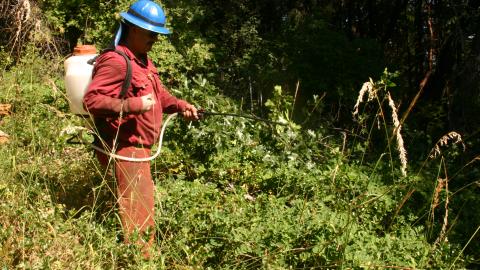
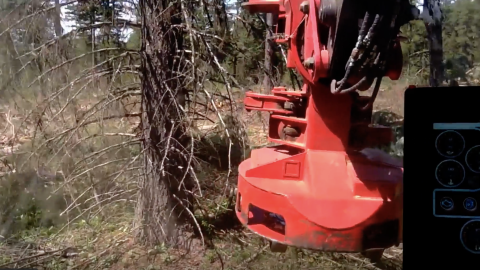
Forest restoration workers do play a critical role in stewarding America’s forests. Unlike loggers, this workforce carries out reforestation and fuels reduction activities, including technical work such as herbicide application and tree falling. This work is often in remote locations and challenging environmental conditions. In the Pacific Northwest, forest restoration crews are mostly Latine and Spanish‑speaking, many with limited access to safety training, labor protections, and job mobility.
The workshop, titled, Habilidades y seguridad para servicios forestales / Forestry Services Skills & Safety Workshop, addressed a persistent gap in forestry safety training. Despite facing high‑risk working conditions, forestry services workers are often underrepresented in formal safety conversations. The day-long training emphasized solutions‑focused learning, blending structured training with facilitated discussion. To finish a full day of learning, supervisors received advanced safety training and joined conversation sessions to identify real‑world solutions to common hazards, providing a space for meaningful peer‑to‑peer knowledge exchange.
“Forestry workers are often hesitant to share, so seeing people actively asking questions, taking notes, and engaging with presenters was truly striking.”
- Vlad Avalos, Forestry Services Educator
Equally important was the emphasis on team‑building. Workers, supervisors, and contractors engaged in open dialogue about shared safety responsibilities, reinforcing that safe forestry workplaces are built through trust, shared learning, and collaboration.
The event extended the success of an earlier project, funded by a federal grant from the OSHA Susan Harwood Program. When federal funding was rescinded in February of 2026, two University of Washington centers, the Pacific Northwest Agricultural Safety and Health Center (PNASH) and the Northwest Center for Occupational Safety and Health (NWCOSH), acted to continue momentum built in the previous year: sustaining outreach to industry partners, and gathering in-kind support from Washington State University Forestry Extension, University of Idaho, Oregon State University, and others.
Assessing the needs of the community
Beginning in 2025, the project funded by the OSHA Susan Harwood Program responded effectively to the realities of the restoration forestry workforce. The project prioritized a comprehensive needs assessment at the outset. Led by the PNASH Center in partnership with the Northwest Center for Occupational Safety and Health and WSU Forestry Extension, the assessment gathered input from 31 stakeholders across Washington, Oregon, and Idaho, including forestry professionals, educators, contractors, and safety consultants involved in forest work and worker training.
The assessment found two primary audiences in need of training and support: small woodland owners and Latine contract forestry crews, including H‑2B visaed seasonal workers. Stakeholders prioritized critical training needs as: chainsaw safety, emergency planning, personal protective equipment, fatigue management, environmental hazards, and mental health. These findings underscored the importance of culturally and linguistically responsive approaches, particularly for Spanish‑speaking crews working for small contract firms.
Insights from the needs assessment directly informed curriculum design, training content, and outreach strategies at two trainings in 2025 and the recent Chehalis training. The results from the pilot year of funding shaped the selection of training topics, the development of bilingual materials, and current recruitment approaches tailored to reach hard‑to‑access contract crews. By grounding the project in stakeholder input, the grant strengthened its ability to reach an often-underserved workforce with relevant, practical, and accessible safety training.
Moving forward
Forest restoration work plays a critical role in stewarding America’s forests. Although the work is inherent with risks, injuries and fatalities are preventable and forestry work is rewarding. Addressing these safety needs requires targeted training, stronger accountability in government and private sector contracting, and policies that recognize and protect the workers whose hands sustain America’s forested lands.